
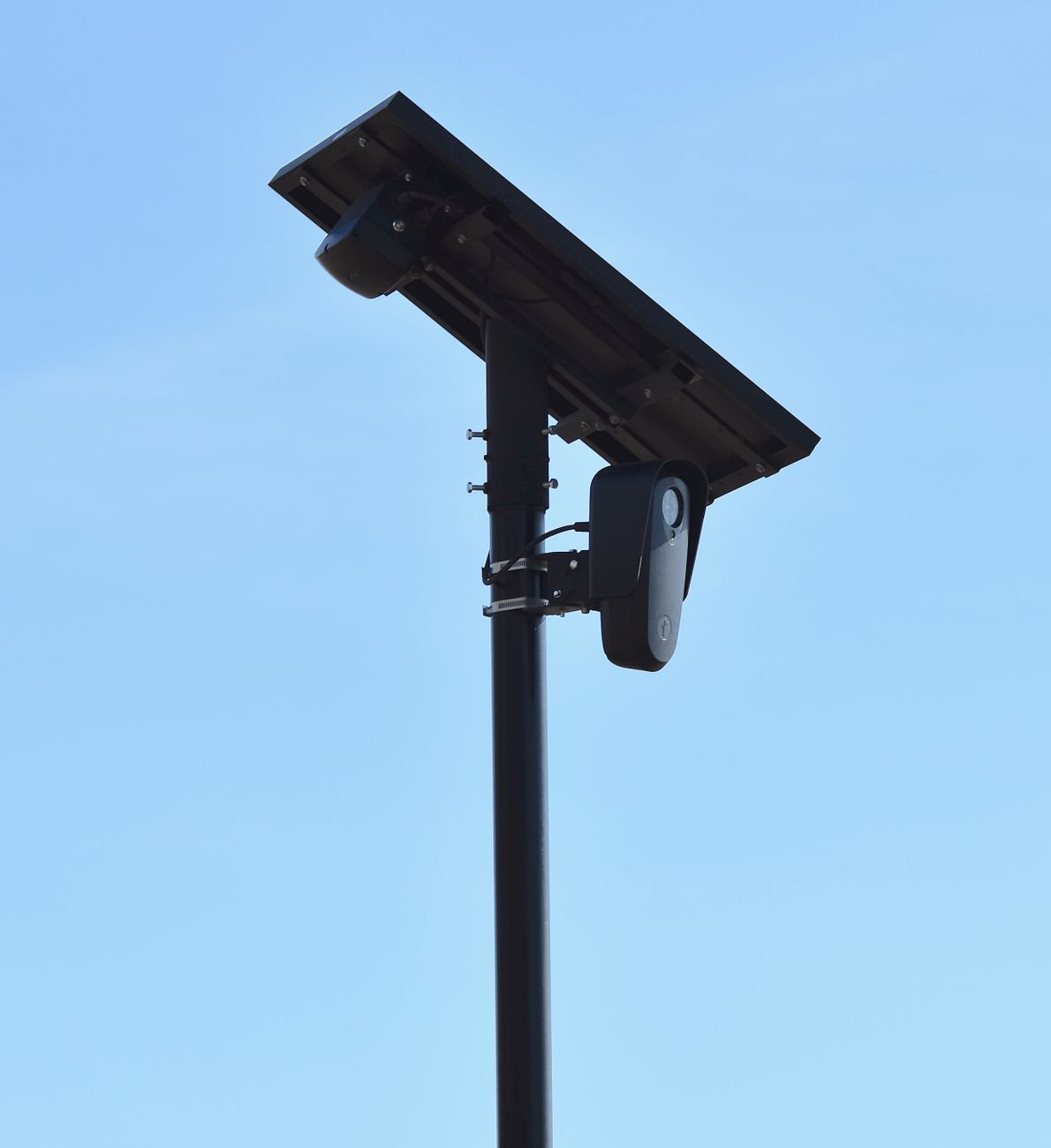
Another Georgia law enforcement officer has been accused of misusing Flock Safety's automated license plate reader system, and once again the alleged misconduct was discovered only after the surveillance had already happened.
The Houston County Sheriff's Office says Deputy Sierra Carroll, a school resource officer, was suspended without pay on August 17 pending termination after an internal audit found that she had misused Flock Safety license plate reader data. Sheriff Matt Moulton said the matter was referred to the District Attorney's Office for possible criminal charges. As of the latest public reporting reviewed by The Ocmulgee Free Press, Carroll had not been criminally charged, and the investigation remained active.
Carroll was hired by the sheriff's office on April 28, 2025, and assigned to the School Resource Unit, according to the agency. The sheriff's office has not publicly disclosed what vehicles were allegedly searched, how many improper searches were identified, who may have been targeted or what prompted auditors to examine Carroll's activity.
Those unanswered questions matter because this is no longer an abstract debate about whether a surveillance system could be abused. Georgia now has a growing list of cases in which law enforcement personnel have been accused of doing exactly that.
The pattern is getting harder to dismiss
One week before Carroll's suspension, three former Bibb County Sheriff's Office deputies were arrested after an audit found they allegedly used Flock license plate data for personal, non-law enforcement purposes involving people with whom they had personal relationships.
Joseph Marquee Callaway, Coznavian Stubbs and Toni Cierra Lewis were each charged with violation of oath by a public officer, misuse of license plate data and stalking-related offenses. Callaway also faced an additional charge involving the unauthorized request or disclosure of criminal history record information. Stubbs and Lewis resigned during the investigation, and Callaway resigned shortly after his arrest.
That Bibb County investigation reportedly began after Flock Safety notified the sheriff's office of possible irregularities. In other words, the system's audit trail did help expose the alleged conduct. It did not prevent the searches from occurring in the first place.
Just three days after the Bibb County arrests, former Milledgeville Police Major Brandon Sellers turned himself in after investigators said the Flock account assigned to him had been used for non-work-related purposes. Sellers was fired and charged with misdemeanor misuse of captured license plate data and felony violation of oath by a public officer. His case was referred for prosecution.
And the Middle Georgia cases followed an earlier investigation in Albany. In July, five Albany Police Department officers were arrested and fired after a Georgia Bureau of Investigation inquiry that began when an internal audit found officers had allegedly acquired and retained license plate data for non-law-enforcement purposes on multiple occasions.
Taken individually, each case involves separate people, separate agencies and allegations that must be proven in court. Taken together, they expose the same structural weakness: authorized access to a powerful surveillance database can be turned toward an unauthorized purpose before an audit, supervisor or automated system catches it.
'Accountability' after the search is not prevention
Sheriff Moulton has emphasized that Houston County has accountability measures in place and that Flock searches require specific case information. After the Albany arrests, he told WGXA that misuse of the system betrays public trust and said his agency was monitoring its own users more closely.
That makes the Carroll case especially significant. The alleged misuse was found inside an agency that had already been publicly discussing the exact risk, had already pointed to its safeguards and had already increased scrutiny because of misconduct elsewhere.
The audit apparently worked in one sense. It identified alleged misuse. But that should not be confused with a system that prevented misuse.
A digital audit trail is evidence of what happened. It is not a lock on the door.
If an officer with valid credentials can conduct an improper search and the system merely records the action for someone to discover later, then the protection depends on how quickly, how often and how seriously those logs are reviewed. An audit performed months later may establish accountability, but it cannot undo the surveillance of a person who should never have been searched.
That distinction has become impossible to ignore as more agencies announce misconduct only after retrospective audits.
Flock's new 'safeguards' look more like damage control
Flock Safety responded to the recent wave of abuse reports with a familiar corporate maneuver: apologize publicly, announce a package of reforms and reassure customers that the problem is being addressed.
CEO Garrett Langley apologized in August after reports of officers using license plate reader systems for personal surveillance. The company then announced that several safeguards that had previously been optional would become mandatory across its law enforcement network.
The timing matters. These measures were not rolled out before the Albany arrests, before the Bibb County arrests, before the Milledgeville case or before the Houston County suspension. They arrived after a string of highly publicized incidents had already demonstrated that the existing system could be abused by authorized users.
Under the announced changes, vehicle searches must be associated with a criminal case and offense type, and Flock says automated auditing will be expanded across law enforcement customers to flag unusual searches. Reporting on the announcement noted that the automated auditing feature had previously been enabled by only about one-third of agencies using the platform.
That raises an obvious question: if automated auditing was important enough to become mandatory only after a national backlash, why was it optional while agencies were already using a system capable of searching people's vehicle movements?
The requirement to enter a case number sounds reassuring, but it does not prove the case number is legitimate. A user intent on conducting an improper search can still enter information into required fields. Unless the system independently verifies that the case exists and that the search is actually connected to that investigation, the new requirement risks becoming little more than another box to check.
The same problem applies to automated anomaly detection. Flagging a suspicious search after it occurs may help identify misuse sooner, but it does not prevent the search itself. The person whose movements were improperly queried has already been searched by the time the alert is generated.
Flock also announced that its default vehicle-location data retention period would be reduced from 30 days to seven days, while allowing information connected to active investigations to be preserved longer. That reduces the default historical window, but it does not change who can search the system, whether an improper search can be performed in real time or whether authorized users can misuse the access they already have.
None of these changes fundamentally alters the architecture that made the documented abuse possible. Law enforcement users still have access to a massive searchable network. The system still depends on those users entering truthful information. Audits still operate primarily after the fact. And the public still has to trust agencies and Flock to catch misuse that the public usually cannot independently see.
Against that backdrop, the announcement looks less like a redesign of Flock's surveillance model and more like an attempt to calm a growing public-relations problem without surrendering the underlying capabilities that make the product attractive to law enforcement in the first place.
The company can call that reform. The public is entitled to ask whether anything meaningful has actually changed.
The public should not have to wait for the next arrest
Law enforcement agencies routinely defend Flock by pointing to successful investigations, stolen vehicle recoveries, missing-person cases and the existence of search logs. Those are legitimate considerations. ALPR technology can be useful in legitimate police work.
But usefulness does not answer the oversight question.
The issue is not whether police can identify examples in which Flock helped solve a crime. The issue is whether agencies can prove that every search of a person's movements had a legitimate law enforcement purpose, whether improper searches can be stopped before they happen and whether the public receives enough information to independently evaluate those safeguards.
The recent Georgia cases suggest that the answer is not nearly as comforting as the sales pitch.
Albany had an audit. Bibb County had an audit. Milledgeville investigated an assigned account. Houston County had accountability measures and says it increased scrutiny after the Albany scandal. Yet officers in each of those jurisdictions were still accused of misusing plate reader data.
That does not prove every Flock search is improper. It proves that 'we have safeguards' is not the end of the conversation.
It should be the beginning of the audit.
Questions Houston County still needs to answer
The public deserves more than confirmation that an employee was suspended. Houston County should disclose, consistent with applicable law, how many searches were determined to be improper, the time period involved, whether the same vehicle or person was searched repeatedly, whether any searches involved someone personally connected to the deputy, how the activity was discovered, how long it continued before detection and whether supervisors had previously reviewed the relevant audit logs.
The sheriff's office should also explain how frequently Flock searches are audited, what patterns trigger review, whether supervisors independently verify case numbers against actual incident records and what changes will be made following this investigation.
Those are not anti-police questions. They are basic oversight questions for any government agency operating a system capable of recording and searching the movements of ordinary people.
Flock Safety and law enforcement agencies have repeatedly asked the public to trust that the technology is used responsibly. The recent arrests, suspensions and policy changes across Georgia make a different standard more appropriate.
Do not ask the public to trust the safeguards. Show that they work.
And if the safeguard only activates after someone has already abused the system, stop calling it prevention.
Sources
WGXA: School resource officer suspended after audit finds misuse of Flock plate reader data
WGXA: 3 Bibb County deputies arrested, charged with Flock camera misuse and stalking after audit
WGXA: Milledgeville police officer turns himself in for alleged Flock camera misuse
WGXA: GBI says five Albany police officers were arrested and fired for alleged Flock misuse
WGXA: Flock Safety mandates safeguards after reports of police misuse